Showing posts with label WEAPONS. Show all posts

Wednesday, November 3, 2010

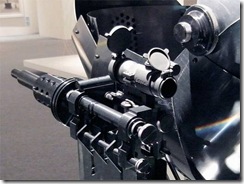
The ultimate weapon or stroller

Full metal shell, both sides equipped with a removable Gatlin six machine guns, weapons may change or deformation at any time. Do you think this is to introduce a new weapon? I also feel a bit like, but is this still the ultimate weapon or modern stroller?


Source:-

Saturday, October 23, 2010

Top 10: Weapons That Changed The World

10 Trebuchet

Siege warfare was one of the most enduring types of warfare, from simple hill forts to imposing stone citadels. Often, the campaigns waged against these structures lasted for months, as the besieged sat behind almost impenetrable walls and moats. The trebuchet completely altered the balance of siege warfare. Firing much bigger projectiles (at much greater distance), and much more accurately than traditional catapults, trebuchets were capable of destroying a stone wall in a matter of days, dramatically improving the chances of a besieging force capturing a city before a relief force could arrive, or their camp was destroyed by disease.


9 Mark I “Mother” tank

While the most famous prototype for a tank was by Leonardo Da Vinci, it was not until World War I that tanks became deployed in warfare. With caterpillar tracks suitable for a wide variety of terrains, thick armor and heavy firepower, the Mark I ”Mother” tank marked a new stage in armored warfare. Much harder to stop than a horse, the British used them to penetrate the fortified German trenches. Tanks became a major part of strategy in WWII, and put an end to the use of trench warfare as a viable mode of conflict.


8 Hellebore

While not a weapon in the traditional sense, biological warfare has been massively significant in human history. Over the centuries, diseased people, poisons and, more recently, weaponized anthrax have all been used to attack enemies. But one of the earliest examples of biological warfare was through the use of hellebore, a common plant with poisonous properties. It was used during the siege of Kirrha in 585 B.C., poisoning the water supply and leaving the defenders too weak to withstand attack. The development of this new weapon in warfare has been refined over the centuries and frequently used with devastating effect.


7 Maxim machine gun

The invention of a viable rapid-fire, automatic weapon did not happen until the mid-19th century, and even then the Gatling gun was not especially effective. It was widely believed that cavalry and infantry combat would remain vital in combat, but this all changed with the introduction of the much more effective Maxim machine gun, during World War I. A weapon that scythed down attackers with ease, cavalry were rendered totally irrelevant, while infantry were liable to massive losses. The machine gun was a major step into fully mechanized warfare, and created loss of life on a scale hitherto unknown.


6 Fokker airplane

Even when flight was a nascent technology, it was applied to military pursuits. Hot air balloons were used to monitor troop movements in battle, zeppelins occasionally dropped bombs and early airplanes were used for reconnaissance.  But it was really during WWI that planes became weaponized. The Fokker was the best of the first wave of fighter planes, fitted with machine guns that could fire through the propeller blades without damaging them, allowing battle to be waged in the skies. To an extent, it also rendered naval warfare obsolete. Ruling the seas was irrelevant if you could not rule the skies too.


5 Chlorine gas

It was perhaps inevitable that as science advanced, its discoveries would be turned to military purposes. During World War I, the Nobel-prize winning scientist Fritz Haber helped develop the first chemical weapon, chlorine gas. This led to rapid development of other weaponized chemicals, such as mustard gas and phosgene. The devastating effect of such weapons led to them being outlawed by the Geneva Convention. They did, however, lead to the development of other equally devastating weapons, such as nerve agents. While as yet they have been used relatively infrequently, the fear of such weapons being used is as prevalent as it was in the trenches.


4 Predator drone

Drones are the ultimate in impersonal conflict. These weapons require virtually no human involvement, travel hundreds of miles and are controlled from extremely safe locations. Officially, they are used only for reconnaissance and intelligence gathering missions. Their greatest impact has been their ability to provide incredibly detailed, accurate and up-to-date information to enable successful strategy planning. It helps minimize resource wastage, and is vital in the concept of surgical strikes, reducing collateral damage and civilian casualties. It also reduces military casualties, as drones are sometimes fitted with hellfire missiles, which can do a lot of damage without risking close engagement with the enemy.


3 Harquebus

Guns are undoubtedly one of the most revolutionary weapons in human history. Although initially they were heavy, slow to load and liable to explode, eventually they became so efficient as to render more traditional weapons obsolete. The first gun that approximated to modern firearms was the harquebus, which was prominent between the 15th and 16th centuries, and was the first gun to be fired from the shoulder. It became prominent because, unlike traditional projectile weapons, it was capable of piercing armor at short ranges, making it much easier to kill heavily armored knights. It brought about the end of armor as effective protection.  


2 Atomic Bomb

The Atomic Bomb is by far the most devastating weapon ever used, and so powerful that on the two occasions it was deployed, there were an estimated 200,000 deaths. This marked the passage of warfare into the atomic age, and was undoubtedly a moment that changed the world. The power of an atomic bomb is so far removed from that of conventional weaponry that it has dominated diplomatic and military strategies ever since. Who would have guessed that a Little Boy and a Fat Man (the names of the two bombs) would together change the world?


1 Bow and arrow

The bow is the most enduringly effective weapon in human history. Evidence indicates origins as early as 12,000 years ago, and they only became obsolete in the 16th century. The bow and arrow, in its various guises, helped develop many great empires. The Ancient Egyptians used archers heavily, the composite bow was a vital component of great nomad invasions of Europe, including the Huns, Avars, Magyars, and Mongols, while the English longbow was a weapon of fear and proved decisive in many battles. These powerful societies were undoubtedly helped by the potency of the bow and arrow, making this a worthy candidate for the top spot.


Source:-

Friday, October 22, 2010

Top 10 Bizarre Weapons of World War II

10 X-Class Midget Submarines


The x-class was a series of submarines built by the Royal Navy during the Second World War. These tiny submarines only displaced 30 tonnes of water when submerged, were 15.55 metres (51ft) long, and carried a crew of 4 (commander, navigator, engineer and diver). There were designed to be towed to the target area by a full-sized “mother” submarine. The X-craft would then be detached and infiltrate the target, laying down two side charges, each containing 2 tonnes of amatol. They would then make their escape and rendezvous with the “mother” submarine to be towed home. The first attack was launched against the German battleship Bismarck. Six X-craft were designated for the operation, but two were lost to accidents en route, and a third suffered mechanical problems. The fourth X-craft was believed to have been sunk by German fire during the attack. The remaining two managed to lay their charges and seriously damage the Bismarck. Other X-craft played an important role with regards to the D-day landings. One surveyed the invasion beaches beforehand and collected soil samples, and two others acted as lightships during D-day itself to guide landing craft to the correct beaches.

9  V-3 Supergun


Developed as a so-called vengeance weapon in order to strike back at London, as Allied bomber fleets pounded German cities to rubble, the V-3 cannon was capable to delivering a 140kg (1310lb) shell to a range of more than 161 km (100 miles). The secret to this enormous range was a number of side channels attached to the 460ft (140m) barrel. These channels each contained an electrically fired propellant charge which helped to accelerate the finned shell to a muzzle velocity of 1500m/s (4920 feet per second). Hitler was most impressed by the prototype, and ordered 25 of them to be built at a site at Mimoyecques, in France. However, this site was heavily bombed by Allied bombers, which forced the Germans to abandon it. Two shorter-barreled versions (164ft) were later built and used against Luxemburg, where they fired a total of 183 shells, only managing to kill 10 civilians and injure 35. Shortly afterwards, both guns were captured by American troops.

8 Sonderkommando “ELBE”


During the later part of the war, Germany became subject to massive bombing attacks by heavy Allied bombers. In desperation, Nazi Germany formed a unit that they hoped would temporarily halt the British and American bomber offensive to give them time to build up large enough quantities of the formidable Me 262 jet fighter, to counter the Allied bombers. This unit would fly Me-109 fighters, which had been stripped of weapons and armor in order to increase their speed. Hermann Goering, commander of the Luftwaffe (German Air Force) proposed that these fighters should wait for the bombers at high altitude. They could then dive at the enemy at high speed, and use their propellers to destroy the bomber’s tail, after which, the German pilot would attempt to parachute to safety. More than 2000 pilots volunteered for the unit, although they only had 180 planes available. The unit’s first attack was launched against a group of American bombers on April 7th, 1945. Of the 120 pilots which took off, only 15 returned, and they only managed to destroy 17 American B-17 bombers and 5 P-52 Mustangs.


7 Ohka (Cherry Blossom) Suicide Plane


As American forces advanced nearer and nearer the Japanese mainland, the Imperial Japanese armed forces became increasingly desperate to prevent Japan’s defeat. The Ohka was developed in a last-ditch effort to destroy the American fleet. It was a purpose-built kamikaze aircraft that was armed with a warhead weighing up to 1200kg. As it had no landing gear, it was carried to the target area by a G4M ‘Betty’ bomber. Once within range, the Ohka was released and steered towards an American ship by the pilot. It would go into a dive before igniting 3 rocket boosters which would accelerate it to up to 650mph before crashing into the enemy ship. At such a high speed, it would be almost impossible to shoot down with anti-aircraft fire. Despite more than 800 being built, however, only a few were used as most were being stockpiled for the anticipated invasion of Japan which never came, thanks to the atomic bomb.

6  Anti-tank dogs


Deployed by the Soviet Union during the Second World War, they were originally deployed in an attempt to halt the German advance during 1941. The dogs were kept hungry, and food was placed under tanks in order to teach them to look under vehicles for food. Each dog was fitted with a 10-12kg mine. The detonator was attached to a 20cm wooden lever which jutted vertically above the dog. When it dived under an enemy tank, the lever would catch on the hull and detonate the mine, killing the dog and hopefully disabling the tank. In action, these dogs proved less than effective. Many were scared away by German gunfire, which caused them to run back to their handlers, often detonating the mine. Other dogs refused to dive under moving tanks as they had practiced on stationery vehicles, and others jumped under Russian tanks. They did succeed in damaging some German vehicles, but Soviet claims that 300 German tanks were put out of action by these dogs is widely optimistic.

5 Bachem BA349 Natter Fighter


Designed near the end of the war, this strange-looking interceptor required no run-way for take-off. Instead, the aircraft was launched up a vertical 8 meter (25ft) rail attached to a small tower. The flight of the fighter would be controlled by radio from the ground until it neared a group of Allied bombers. Then, the pilot would take over and jettison the nosecone to fire off salvos of rockets into the formation. After firing off all of the rockets, and running out of fuel, the plane would glide down to 3000m (10,000 ft), whereupon a number of parachutes in the rear fuselage would deploy. The entire front of the aircraft (including the cockpit) would detach from the tail, and then the pilot would (hopefully) parachute to safety. Only the pilot and the tail (containing the rocket engine) would be recovered from each mission – the cockpit, wings, and nose were all expendable. Despite the death of a test-pilot during the first manned launch of the plane, 36 of these fighters were built, although none were before the end of the war.

4 Bat Bombs 


Developed by America in the wake of Pearl Harbor, this seemingly ridiculous idea proposed that hundreds of bats should be captured, and a tiny incendiary bomb be attached to the body of each. These bats would be placed in a bat carrier which would subsequently be dropped from a bomber. A parachute would deploy at 1000 feet to slow its descent, and the trays inside the carrier would separate out to allow some 1040 bats inside to escape. Once free of the carrier, the bats would disperse and roost throughout the buildings of the Japanese city beneath. Shortly afterwards, the timer-delayed bombs would detonate, sparking raging fires throughout the mainly wood and paper buildings. During one test drop, a group of bats roosted inside several of the testing facilities’ warehouses and buildings, burning them to the ground. Luckily for thousands of bats, the program was cancelled in 1944, due to the development of the atomic bomb.

3  Pigeon Guided Missile


This was yet another attempt to use an animal to deliver explosives to an enemy target. It was first proposed by American psychologist B.F.Skinner, as a way to delivering a missile accurately against a target, by placing a pigeon inside the missile. An image of the target would be projected in front of it, and the pigeon would be trained to recognize it. It would then peck on one of four levers (up, down, left or right) until the target was dead centre of the screen. They were encouraged to do so by their training, where they were awarded with corn for keeping the target in the centre. They were surprising adept at this, (in training) being able to track a target which jumped 4 or 5 inches a second on the screen. The National Defense Research Committee committed $25,000 to this research, and the army modified several missiles for this purpose before it was decided that electronic guidance would be superior, and the project was scrapped.

2 Project Habakkuk


 Project Habbakuk was the name of an ingenious project thought up by Geoffrey Pyke. He envisaged that by taking a large iceberg of ice floe, levelling off the top, and hollowing out the inside, it could be used as a landing platform for aircraft. At the time, the Allies were losing huge numbers of supply ships to German U-boats in the Atlantic. Aircraft were extremely adept at hunting and destroying surfaced U-boats, but they lacked the range to cover the entire Atlantic. Providing a landing platform in the middle of the ocean would therefore give the U-boats nowhere to hide. However, ice proved unsuitable as it split easily, and icebergs themselves are prone to rolling over. Fortunately, two scientists in New York soon discovered that by freezing water with wood pulp, they could create a strong but buoyant substance they christened pykrete. The final design called for a giant carrier 600m (2000ft) long, built out of pykrete, fitted with an extensive cooling system to prevent the pykrete melting, displacing 2.2 million tons, and carrying 150 planes. Unfortunately, research was halted in early 1944 for a number of reasons: the growing numbers and effectiveness of conventional carriers, the huge cost ($100 million) involved, and the technical difficulties of building and refrigerating such a massive structure.


1 Silbervogel (Silver Bird) Bomber


 This was probably one of the strangest and most radical weapons Germany proposed during the Second World War. It was a candidate for the ‘Amerika Bomber’ initiative, which attempted to develop a bomber which had the range to attack mainland America. It was based upon the idea of placing a plane on a 3 km (2 mile) long rail, which would be propelled to 1900 kph (1200mph), by a rocket-powered sled. Once airborne, the Silbervogel would then fire off its own rocket engines to propel it to a height of 145km (90miles), traveling at 22100 kph (13700 mph). It would then slowly descend into the stratosphere, where the flat body of the plane would generate lift due to the increasing air density. This would cause it to rise again, and the plane would progress around the world in a series of ever shallower ’bounces’. It would then deliver a 4000kg (8800lb) bomb (possibly radiological) to somewhere in America, before landing at a Japanese base in the Pacific. In the end, the project was far beyond the capabilities and resources of Nazi Germany, and only existed as a mock-up

Source

Thursday, October 21, 2010

These guns can’t kill you – they are ice cream


At first glance it looks like they’re putting real guns in their mouths, but in real life they are eating edible ice guns.

They all have different kinds of flavors–cola, cherry, licorice and black currant. They are an addition to the first 50 tinted ice guns that Florian Jenett and Valentin Beinroth made and placed in downtown Frankfurt a few years ago.
These edible eatables where exhibited at an art show called “Freeze Revisited”, and their existence certainly shocked a lot of people.


Source:-

Tuesday, September 28, 2010

Dragunov Sniper Rifle

The Dragunov, specifically the Dragunov SVD, is one of the most popular sniper rifles in the world today. The Russian Dragunov SVD is considered, by collectors, to be one of the most highly prized trophies of all time.

So why is the Dragunov such a popular firearm? Why do so many people want one, and why is it so great?

Let's talk about the Dragunov, what it is, what it does, and the different types of Dragunov sniper rifles in production today.

What is a Dragunov sniper rifle? 

A Dragunov is a type of semi-automatic, gas-operated rifle manufactured originally in the Soviet Union. This is a rugged and reliable firearm which uses a powerful round, effective for up to 3200 feet (1000 meters). It has a chrome-lined barrel, for corrosion resistance. The Dragunov also has a slotted flash suppressor.

The Dragunov bears a number of similarities to the world-famous AK design including the large dust cover, iron sights and lever safety selector.

The Dragunov is classified as a "squad support weapon." It is meant to extend the range of the standard infantry squad mostly equipped with AK-47s or similar mid-range firearms. The Dragunov has a much longer range and greater accuracy than AK-type firearms. The shortcoming of the Dragunov is the smaller round capacity and the lack of a fully automatic rate of fire.

Dragunov Rifle Characteristics 

How do you know it's a Dragunov?

Dragunov rifles share a similar look. After a while you will find that you can distinguish a Dragunov from similar long-barreled rifles by its distinguishing features.

In no particular order, here are the common features of a Dragunov:

1. Long barrel

As befits a sniper rifle, most Dragunovs have a long barrel. Barrel lengths range from 23-24 inches. Note that there are some modern-production Dragunov carbines with shorter barrels but these are certainly not sniper rifles due to the loss of power and accuracy the short barrel causes.

2. Semi-automatic

All Dragunov rifles are semi-automatic. This means that each pull of the trigger fires a single shot.

Semi-automatic firearms are intrinsically less accurate than bolt-action firearms. However, most of the world's modern armed forces have transitioned to semi-automatic sniper rifles due to the rapidity of a follow-up second shot and ease of reloading.

3. Magazine-fed

Dragunovs are loaded by a magazine inserted into the bottom of the receiver. Magazines contain 5-10 rounds each.

4. Skeletonized stock

Nearly all Dragunov-style rifles have a skeletonized stock. This means that the stock (the wooden section held to the user's shoulder) is not a single solid unit. Instead, it has cavities or large missing sections in it.

Some Dragunov-type rifles have folding stocks. This is not a characteristic found on most sniper rifles. Fixed, or non-folding, type stocks are more rigid and are favored by snipers and other long-range shooters.

5. Scopes

Sniper rifles always have optical aiming devices (aka "scopes") mounted atop them. All Dragunov-style rifles come with an optical scope affixed to the receiver.

An interesting feature of Dragunov scope mounts is that they are set high above the receiver (the body of the rifle). This enables the user to peek below the scope and use the iron sights (mounted on the receiver and end of the barrel) to make shorter-range shots.

Dragunov scope reticle 

Here's what you see when aiming at your target!

The scope reticle ("reticle" means what you see when you look in the scope) is much more complicated than the traditional crosshairs. Additionally, the PSO-1 type scope often is either illuminated via tritium, illuminated via LED or has infrared or starlight capacity. This makes the sniper even deadlier in all settings!

Here's what it means:

The horizontal axis

The horizontal axis has a number of hash marks -- ten each on the left and right side. This helps the sniper to factor in wind drift when shooting at long ranges. Depending on range and wind speed, the shooter will aim to right or left of the actual target.

The vertical axis

The vertical axis has several ^-shaped marks. Each of these indicates the bullseye at a different range. The farther the range, the lower the ^ indicated on the sight.

The stuff on the lower-left corner

This diagonal line marked from 2-10 is the brilliant part of the Dragunov scope reticle. The intention here is that the marks indicate the average height of a man. If a target that you see in your scope stands on the bottom horizontal line and touches the "2" pip, then the target is 200 meters away. This "quick and dirty" range estimate is good up to 1000 meters (3290 feet, or 3/4 mile!).

Although this rangefinder technique is far less reliable than today's laser technology, it is also much more robust and reliable.

What makes a Dragunov a sniper rifle? 

A sniper rifle has three characteristics:

1. Range (long range)
2. Accuracy (maintains accuracy at long battlefield ranges)
3. Portability (one-person portable)

The Dragunov has a long range and is reasonably accurate (though not as accurate as bolt-action rifles with a similar range). It is easily portable by a single soldier.

The Dragunov is typically classified as a "designated marksman's weapon." That means that the best sharpshooter in a squad (6-12 soldiers) is equipped with this long-range weapon.

An actual sniper, whose sole responsibility is extremely long-range neutralization of enemy targets, typically is equipped with a more accurate weapon. Over half of the world's sniper rifles are bolt-action (which provide an intrinsic accuracy benefit over semi-automatic actions, at the cost of much slower follow-up shots).

Where can I get a Dragunov? 

My favorite online gun seller is Impact Guns. These sellers have some of the best selection and prices you'll find anywhere.

Impact Guns is highly recommended.

Monday, September 27, 2010

Top 10 Badass Ancient Weapons

Long before drive by shootings and police stabbings, our ancestors used some truly badass weapons against each other. Our ancient ancestors seemed to have a knack for finding the most gruesome and painful ways to attack each other – you could even argue that no modern weapons come close to being able to inflict the same level of suffering as these ancient weapons. You might even be forgiven for being thankful for guns with their quick deaths when you read this list of top 10 badass weapons.
This is a list of the most badass weapons in ancient history. This list excludes weapons beyond the medieval period.
10
Culverin
Culverin
Coulevriniers
Culverins were medieval guns. These were often used by horsemen in a medieval kind of drive-by shooting. The hand culverin were made of a simple smoothbore tube, closed at one end except for a small hole designed to fire the gunpowder. The tube was held in place by a wooden piece which could be held under the arm. The tube was loaded with gunpowder and lead bullets. The culverin was fired by inserting a lighted cord into the hole. In the image above, the hand culverin is between two small canons.
These hand culverins soon evolved into heavier portable culverins, around 40kg in weight, which required a swivel for support and aiming. Such culverins were further equiped with back-loading sabots to facilitate reloading, and were often used on ships – a precursor to the modern canon.
9
Caltrop
Caltrops
A caltrop is a weapon made up of two (or more) sharp nails or spines arranged so that one of them always points upward from a stable base (for example, a tetrahedron). Caltrops serve to slow down the advance of horses, war elephants, and human troops. It was said to be particularly effective against the soft feet of camels.
Weapons Caltrop
In modern times Caltrops have been used at times during labor strikes and other disputes. Such devices were used by some to destroy the tires of management and replacement workers. Because of the prevalence of caltrops during the Caterpillar strike of the mid-1990s, the state of Illinois passed a law making the possession of such devices a misdemeanor.
Iron caltrops were used as early as 331 BC at Gaugamela according to Quintus Curtius. They were known to the Romans as tribulus or sometimes as Murex ferreus, meaning ‘jagged iron’. The Roman writer Vegetius said:
The Roman soldiers rendered [the armed chariots] useless chiefly by the following contrivance: at the instant the engagement began, they strewed the field of battle with caltrops, and the horses that drew the chariots, running full speed on them, were infallibly destroyed. A caltrop is a device composed of four spikes or points arranged so that in whatever manner it is thrown on the ground, it rests on three and presents the fourth upright.
Punji sticks and caltrops were used in the Vietnam War, sometimes with poison or manure on the points.
8
Boiling Oil
Castle
Back in the day, you had to scale the walls of a city or castle before you could rape and pillage. This led someone to the brilliant idea that you could pour boiling oil on top of the people trying to climb in.
Oil
Oil was not difficult to come by as the women would all donate their cooking oil (a small price to pay to keep their privates private). If the town ran out of oil, they would use boiling water, or other easily obtainable things like sand.
Castles were often built with special holes in the sides to make it easier to pour this blistering liquid on unsuspecting climbers. They were so effective that they were called murder-holes. These holes were also useful for firing arrows at attackers or throwing rocks. Similar holes, called machicolations, were often located in the curtain walls of castles and city walls. The parapet would project over corbels so that holes would be located over the exterior face of the wall, and arrows could be shot at, rocks dropped on, or boiling water poured over, any attackers near the wall.
Various sources claim that molten lead was also used as a weapon in this way, but there is no historical evidence to support that view.
7
Arbalest
Arbalette-P1000546
We all know that crossbows are badass – but what about the arbalest? The Arbalest was a larger version of the crossbow and it had a steel prod (“bow”). Since an arbalest was much larger than earlier crossbows, and because of the greater tensile strength of steel, it had a greater force. The strongest windlass-pulled arbalests could have up to 22 kN (5000 lbf) strength and be accurate up to 500m. A skilled arbalestier (arblaster) could shoot two bolts per minute. Arbalests were sometimes considered inhumane or unfair weapons, since an inexperienced crossbowman could use one to kill a knight who had a lifetime of training.
Innocentii
The use of crossbows in European warfare dates back to Roman times and is again evident from the battle of Hastings until about 1500 AD. They almost completely superseded hand bows in many European armies in the twelfth century for a number of reasons. Although a longbow had greater range, could achieve comparable accuracy and faster shooting rate than an average crossbow, crossbows could release more kinetic energy and be used effectively after a week of training, while a comparable single-shot skill with a longbow could take years of practice. Crossbows were eventually replaced in warfare by gunpowder weapons, although early guns had slower rates of fire and much worse accuracy than contemporary crossbows.
This weapon was so badass, that Pope Innocent II (pictured to the left) banned them at the second Lateran Council in 1139:
We prohibit under anathema that murderous art of crossbowmen and archers, which is hateful to God, to be employed against Christians and Catholics from now on.
Today the crossbow often has a complicated legal status due to the possibility of lethal use and its similarities with both firearms.
6
Hunga Munga
Hungamunga
The Hunga Munga is an iron fighting tool named by the African tribes south of Lake Tchad; also called “danisco” by the Marghi, “goleyo” by the Musgu, and “njiga” by the Bagirmi. It is handheld weapon and has a metal pointed blade with a curved back section and separate spike near the handle. The weapon can be used in hand to hand combat (Melee) although it is normally thrown with a spinning action.
Buffy
These African iron weapons are thrown with a rotatory motion (similar to an Australian boomerang), and cause deep wounds with their projecting blades. They come in many shapes and sizes and they were (and are) used across Africa from the Upper Nile on the east through Central Africa by Lake Tchad to the Africans of the Gaboon in West Africa. In parts of Central Africa, these weapons are shaped like a bird’s head.
This weapon is used in the Role-Playing game Mage The Ascension by the Euthanatos characters for their magical rituals. Buffy (from Buffy the Vampire Slayer – image to the right) used one of these from time to time to battle demons that enslave their victims and force them to give up their identities. The hunga munga was used in the opening credits of the show.


5
Morning Star
Fomfr Morning Star
The Morning Star (also sometimes called the goedendag or Holy Water sprinkler) is a term used for a variety of club-like weapons with one or more sharp spikes sticking out of it. It would normally have one big spike poking out of the top with a bunch of smaller ones around the sides. These are often thought of as peasant weapons, but there were also very high quality ones made for the rich guys.
Havik
These weapons were most effective when you hit someone on the head with them. The Holy Water sprinkler, was a morning star popular with the English army from the sixteenth century and made in series by professional smiths. Some of them were over 6 foot long! This was the favored weapon of King John of Bohemia who was blind – he would just sit on his horse and swing the thing until he hit someone (preferably one of the bad guys).
In the game Mortal Kombat Deception, the character Havik (in the picture to the right) weilds a morning star in his form of armed combat. The Morning Star is considered to be a Holy Weapon in Dungeons and Dragons. Of course, when not engaged in battle, this was a useful tool for keeping thine wyfe and kids in line, or as a backscratcher. Badass!
4
Dead Bodies
Plagueguys
One of the upsides to siege warfare in the middle ages was the huge number of dead bodies from people who had died of plague or other mysterious illnesses. A very handy use for these bodies was biological warfare! Most towns would barricade themselves behind huge walls that could not be breached by the enemy – but they often relied on outside sources of fresh water. This is where the bodies come in. You could dump a few bodies in the rivers leading in to the town and all you had to do was wait! A perfect opportunity to sit back and watch some jousting.
Jane
After a while, the plague would infect the town and you have a great victory! Obviously you can’t rape and pillage too soon, but at least you didn’t lose any men (except maybe the poor guys that had to carry the bodies to the river). In the image to the left, we see Jane Godbotherer being treated for the plague. She will eventually end up being used as a biological weapon.
Plague infection in a human occurs when a person is bitten by a flea that has been infected by biting a rodent that itself has been infected by the bite of a flea carrying the disease.
This type of warfare was used before the advent of catapults which were more much more effective at infecting towns with disease.
3
Trebuchet / Catapult
Trebuchet
With the advent of the trebuchet (a very high powered catapult) came the realization that plagued bodies were no longer needed to slowly kill people in a fortified town or castle – you could simply catapult a rotting or diseased animal over the ramparts – or for truly fast results, you could fling over a few beehives. Dead horses were a popular weapon in this form of biological warfare, though anything filled with disease would do the trick.
The counterweight trebuchet appeared in both Christian and Muslim lands around the Mediterranean in the twelfth century. It could fling three-hundred-pound (140 kg) projectiles at high speeds into enemy fortifications. Trebuchets were invented in China in about the 4th century BC, came to Europe in the 6th century AD, and did not become obsolete until the 16th century, well after the introduction of gunpowder. Trebuchets were far more accurate than other medieval catapults.
The trebuchet could launch projectiles a distance of over half a mile (over 750 m).
2
Greek Fire
Skylitzes-Greekfire
Picture, if you will, a slow day on the seas. The water is calm, the sky is blue, when suddenly, from out of nowhere, it starts raining fire! You discover that you have just been engaged by a Greek warship and they have flame-throwers! Yes – that’s right, the Greeks used flame-throwers in their naval battles from around 670 AD. So what do you do when you are being fired on by flame-throwers? According to one witness:
“Every time they hurl the fire at us, we go down on our elbows and knees, and beseech Our Lord to save us from this danger.”
Chinese Flamethrower
In other words, not much! The recipe for Greek fire was a closely guarded secret – even now no one really knows what it was made of. Modern scientists have ventured a few guesses: petroleum, niter, sulfur; or naphtha, quicklime, sulfur; or phosphorus and saltpeter. Regardless of the recipe, the stuff was heated in a cauldron on the ship and squirted out a giant syringe at the enemy.
But… the Chinese beat them to it
In the 3rd century BC, a flammable liquid substance was found in the Gao Nu County, located in the northeast portion of what is now the Shaanxi Province. This “flammable liquid” (called Meng Huo You) was probably petroleum that had seeped through the ground and was floating above the local waters. Ever the ingenious people, the Chinese put it to good use in destroying towns built with timber.
In 900 AD, the Chinese also invented the Pen Huo Qi – a piston based naphtha flamethrower. The double-piston pump flamethrower was carefully documented and illustrated in the Chinese military manual known as the Wujing Zongyao (image on the right). It was, of course, used in siege warfare.
1
Scythed Chariot
Chariot
I am sure most will agree that it doesn’t get more badass than this. A scythed chariot was a war chariot with one or more blades mounted on both ends of the axle. The scythed chariot was pulled by a team of four horses and manned by a crew of up to three men, one driver and two warriors. Theoretically the scythed chariot would plow through infantry lines, cutting combatants in half or at least opening gaps in the line which could be exploited. It was difficult to get horses to charge into the tight phalanx formation of the Greek/Macedonian hoplites (infantry). The scythed chariot avoided this inherent problem for cavalry, by the scythe cutting into the formation, even when the horses avoided the men.
The blades extended horizontally for a meter on the sides of the chariot. Xenophon, an eyewitness, describing the scythed chariots at the battle of Cunaxa says, “These had thin scythes extending at an angle from the axle and also under the driver’s seat, turned towards the ground”.
A scythed chariot can be seen in the chariot race of the movie Ben Hur, operated by Messala (here called a “Greek chariot” or a “beaked chariot.”). Scythed chariots are seen in the first Colosseum scene in the movie Gladiator. In the film Alexander by Oliver Stone, scythed chariots are shown charging into Macedonian phalanx during the beginning of Battle of Gaugamela scene.
This article is licensed under the GFDL because it contains quotations from the Wikipedia articles: Crossbow, Caltrop, Trebuchet, Scythed Chariot